
|
No doubt the Stillen makes good power on the dyno compared to the stock boxes, but is hard to simulate what the factory intakes are designed for on a dyno.
|
|||||||
 |
|
|
LinkBack | Thread Tools | Display Modes |
 05-10-2011, 10:50 AM
|
#16 (permalink) |
|
Base Member
Join Date: Nov 2009
Location: Plano, TX
Posts: 74
Drives: 09 G37S Sedan 6MT
Rep Power: 17  |

No doubt the Stillen makes good power on the dyno compared to the stock boxes, but is hard to simulate what the factory intakes are designed for on a dyno. They are specifically made to operate more effectively while the car is in motion, and designed to force more air in as speed increases (something a dyno cannot replicate). Even with large fans this is difficult to simulate on a dyno.
With the above said, Stillen is really the only intake that has proven to produce any noticeable gains on the VQ37VHR, so if you are going to drop your cash on an intake, go with Stillen (not a huge Stillen fan, but I will give them some credit). The 4-5 HP you end up with is not worth $500 and hacking up your car to me, but I know it is to some and you can't argue that they don't sound good.
__________________
2009 G37S Sedan-6MT: Advan / Volk / Tein / SPC / Invidia / Cobb / K&N |

|

|
|
05-10-2011, 11:07 AM
|
#17 (permalink) |
|
Base Member
Join Date: Nov 2009
Location: Plano, TX
Posts: 74
Drives: 09 G37S Sedan 6MT
Rep Power: 17 |
I also find it interesting that in the most high performance version of this engine, (used on the Nismo 380RS) they use the exact same stock air boxes. I think if an intake really performed better a) Nismo would know best, and b) they would be all over it. Also, let me remind you, Nismo makes similar intakes for these engines, and they are no where to be found on the most expensive high performance variant of this motor.....
EDIT: Actually, after looking into this again, it looks like they switched to a cone style intake in a CF "suction" box, but in the stock locations on the 380RS-C, along with a Motec, and new plenum.... 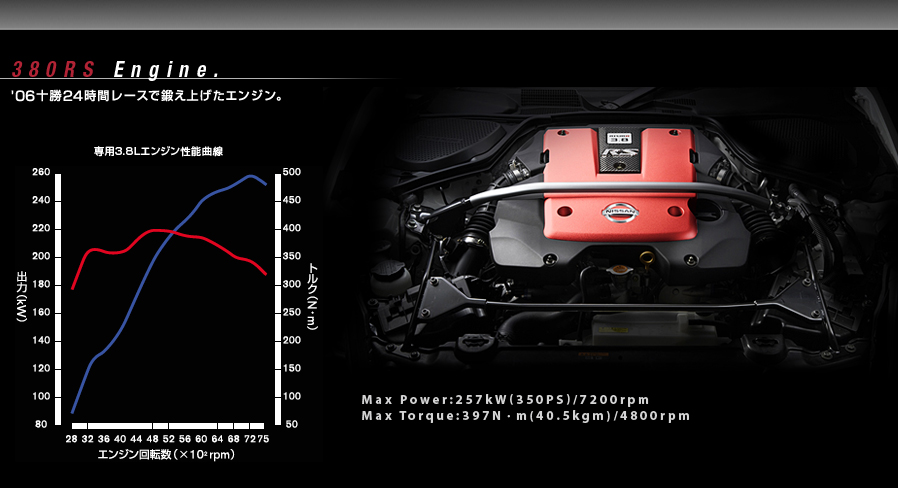 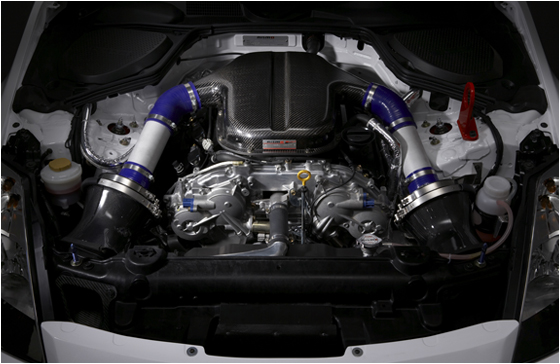
__________________
2009 G37S Sedan-6MT: Advan / Volk / Tein / SPC / Invidia / Cobb / K&N Last edited by jran76; 05-10-2011 at 11:19 AM. |
|
|
|
|
05-10-2011, 11:19 AM
|
#18 (permalink) | |
|
A True Z Fanatic
 
Join Date: Mar 2009
Location: Houston, TX
Posts: 4,024
Drives: too slow
Rep Power: 3596  |
Quote:
Bad airflow could result in a lack of available air/pressure at the filters (i.e. maybe your intake placement is so bad that the engine can't draw in the air volume it wants to, because of a low pressure area near the filters at speed). Most intake designs aren't so tragically poorly tested as to suffer from this problem though. Mostly intake changes are only going to affect a car significantly in one of four basic ways (most of which can be seen on the dyno, to some greater or lesser degree, or can be seen by monitoring intake air temps while driving): 1) Changing the CFMs allowed to flow through the filters. Assuming the intakes/filters are restricting intake flow to a lower CFM than what the engine would otherwise pull, getting rid of some of that restriction will help at high air flow volumes (high rpm). 2) Changing the temperature of the intake air (IAT) (colder is better, and the more you're picking up external air instead of engine bay air, the colder it gets). 3) Changing the available air volume in the intake tubes (between the filter and the intake plenum proper). I don't claim to fully understand the effect of this. it would seem this would improve response to the throttle plates opening up, since you have more available post-filter air to immediately suck in via engine vacuum. On the other hand, if it effectively acts as an extension of plenum volume (does it?) it would actually reduce your throttle response by a bit. 4) Airflow smoothness. Ideally you want laminar flow, no crazy turbulence to hold up the engine's draw of air. Changing the intake configuration could have large positive or negative effects here. We know, for example, that it's obvious an intake like the Stillen Gen3 wins over the stock setup on items 1 and 2 (CFM and temps). Even if you put K&N drop-ins on your stock airboxes the G3 still wins on CFM, just look at the filter area and it's obvious. There are ways to get the stock airboxes to beat the G3 on IAT (e.g. intake ducts cut into the top of the bumper that route directly to the stock holes through the radiator core support), but they look a lot more rain-problem-prone than the default G3 setup. For that sort of thing, I'd rather run an L-shaped duct up to the G3s (e.g. Modshack's custom ductwork) which would tend not to push water up into the intake and again lower IAT further. As far as airflow smoothness goes, the G3 seems to be designed well. Post-MAF tubes that replace the factory crinkly-tubes probably help with that as well. I think the only real question where people might have doubts after trawling through all the available evidence and design factors is: what exactly are the effects of the greatly-increased intake tube air volume the G3's have between the filters and the throttle bodies? Whatever your take on that issues is though, I don't believe it would be affected by rolling airflow to the bumper. FWIW my G3 setup has great throttle response in neutral. I don't remember detecting any increased throttle lag from that install. |
|
|
|
|
|
05-10-2011, 11:53 AM
|
#20 (permalink) |
|
Base Member
Join Date: Nov 2009
Location: Plano, TX
Posts: 74
Drives: 09 G37S Sedan 6MT
Rep Power: 17 |
Just a couple comments because I am too lazy to respond to all of it (and I agree with most of what you are saying)....
Turbulent air is more of an issue at the MAF sensors, or pre-MAF, and I will agree that in general turbulent air is a bad thing (it just has less of an affect once being sucked in under vacuum). The biggest issue (and one that some aftermarket intakes suffer from) is the affect of turbulent air has on readings by the MAF sensor. I do think Stillen's design helps keep turbulent air to a minimum pre-MAF, and one of the primary reasons it performs better than most other aftermarket intakes. From all the testing I have seen (by 2-3 extremely reputable companies), there is nothing to indicate the stock boxes are in any way restrictive, or cannot provide enough air to the engine. I think the Stillen brings in slightly cooler and more air on the dyno, and that is the big advantage. At speed, I don't think the amount of air the factory boxes can flow is an issue. They are also bringing in a lot of the cooler air the Stillen is going to pull in once the car is in motion. Also, one last comment on the throttle plates/bodies, according to Mike Kojima (who did a lot of research on the VQ37VHR early on): "The unique VVEL system completely controls the intake valves opening and closing events.... The command authority of the VVEL system is great enough so controlling valve opening is the primary means of throttling the VQ37VHR’s output, instead of traditional throttle plates.The VQ37VHR does retain twin drive by wire throttles but they mostly stay wide open, the only time they close is on overrun to help provide engine braking and if the engines ECU detects low vacuum in the brake booster reservoir." Reference (full article): Edit.... The link is blocked, I guess because it is from another site (god forbid should we share relevant information). If anyone really cares about it, I am sure you can search for Mike Kojima's site and find the article I quoted.
__________________
2009 G37S Sedan-6MT: Advan / Volk / Tein / SPC / Invidia / Cobb / K&N Last edited by jran76; 05-10-2011 at 11:57 AM. |
|
|
|
|
05-10-2011, 12:04 PM
|
#21 (permalink) |
|
Base Member
Join Date: Nov 2009
Location: Plano, TX
Posts: 74
Drives: 09 G37S Sedan 6MT
Rep Power: 17 |
One more thing.... I know there are lot of people on here that love their Stillen intakes, and I think that is great. You are very passionate about them, and I know I am not going to change your mind. There is nothing wrong with the Stillen intake. It is a lot better than any other aftermarket intake I have seen or researched. My only point is that the stock air boxes are not a problem compared to some of the other restrictions.
__________________
2009 G37S Sedan-6MT: Advan / Volk / Tein / SPC / Invidia / Cobb / K&N |
|
|
|
|
05-10-2011, 12:47 PM
|
#22 (permalink) |
|
A True Z Fanatic
Join Date: Jul 2009
Location: Ontario Canada
Posts: 1,660
Drives: 370 Z 7AT Sports
Rep Power: 21 |
My G3 stillen made 20 rwhp over the stock intake. It was my first mod.
baseline stock car 264.. with stillen 284.rwhp SAE. Mine is a 7 AT. sports have the dyno charts to back it up. Z
__________________
 12.343 @114.14 . 4.5 stroker motor is now being built. Dec 1 2015. 12.343 @114.14 . 4.5 stroker motor is now being built. Dec 1 2015.
|
|
|
|
|
05-10-2011, 01:00 PM
|
#23 (permalink) | |
|
Base Member
Join Date: Nov 2009
Location: Plano, TX
Posts: 74
Drives: 09 G37S Sedan 6MT
Rep Power: 17 |
Quote:
__________________
2009 G37S Sedan-6MT: Advan / Volk / Tein / SPC / Invidia / Cobb / K&N Last edited by jran76; 05-10-2011 at 03:16 PM. |
|
|
|
|
|
05-10-2011, 03:09 PM
|
#24 (permalink) | |
|
Base Member
Join Date: Apr 2011
Location: California
Posts: 156
Drives: M6 Silver Roadster
Rep Power: 16 |
Quote:
It is amazing what these CAI can do for Z's engine. On my old 1998 prelude (H22A4), CAI, headers, and exhaust only netted 10hp. What a difference. |
|
|
|
|
|
05-10-2011, 03:14 PM
|
#25 (permalink) |
|
Base Member
Join Date: May 2010
Location: Baltimore Md
Posts: 131
Drives: 40th anniver 370Z
Rep Power: 17 |
I am not really in to a lot of the tech stuff about the air intake system, But I do know that my car performs better with the stock intakes, Also thanks for all the positive feed back.
__________________
2010 40th Anniversary Z Owner |
|
|
|
|
05-10-2011, 06:49 PM
|
#26 (permalink) | |
|
A True Z Fanatic
Join Date: Mar 2009
Location: Houston, TX
Posts: 4,024
Drives: too slow
Rep Power: 3596 |
Quote:
|
|
|
|
|
|
05-10-2011, 06:53 PM
|
#27 (permalink) | |
|
A True Z Fanatic
Join Date: Mar 2009
Location: Houston, TX
Posts: 4,024
Drives: too slow
Rep Power: 3596 |
Quote:
|
|
|
|
|
|
05-10-2011, 07:03 PM
|
#28 (permalink) | |
|
A True Z Fanatic
Join Date: May 2009
Location: Central Florida
Posts: 1,884
Drives: '12 Corvette GS 6M
Rep Power: 21 |
Quote:
__________________
Current Ride: 2012 Chevrolet Corvette Grand Sport Centennial Edition Carbon Flash 6M Previous Ride: 2009 Nissan 370Z Sport Platinum Graphite 7AT |
|
|
|
|
|
05-10-2011, 08:06 PM
|
#29 (permalink) | |
|
Base Member
Join Date: Nov 2009
Location: Plano, TX
Posts: 74
Drives: 09 G37S Sedan 6MT
Rep Power: 17 |
Quote:
__________________
2009 G37S Sedan-6MT: Advan / Volk / Tein / SPC / Invidia / Cobb / K&N |
|
|
|
|
|
05-10-2011, 08:12 PM
|
#30 (permalink) | |
|
Base Member
Join Date: Nov 2009
Location: Plano, TX
Posts: 74
Drives: 09 G37S Sedan 6MT
Rep Power: 17 |
Quote:
__________________
2009 G37S Sedan-6MT: Advan / Volk / Tein / SPC / Invidia / Cobb / K&N |
|
|
|
|
|
| Bookmarks |
|
|
 Similar Threads
|
||||
| Thread | Thread Starter | Forum | Replies | Last Post |
| HKS drop ins | Rays | Intake/Exhaust | 26 | 08-25-2010 09:28 AM |
| get a drop box! | saqib55 | The Lounge (Off Topic) | 4 | 07-03-2010 08:15 PM |
| anybody use k&n drop-ins for they're z? | O'DoyleRules | Intake/Exhaust | 3 | 12-14-2009 09:41 AM |
| K&N Drop-ins? | blinkme323 | Intake/Exhaust | 28 | 11-15-2009 07:34 PM |
| K&N drop in vs HKS drop in | ddvette9 | Intake/Exhaust | 2 | 11-01-2009 12:30 PM |



 Aaaamen!! Good sermon.


 Linear Mode


